




Key Takeaways
- Scrum is an Agile framework that helps teams deliver valuable work in short, timeboxed cycles called sprints.
- Agile is the broader mindset and set of principles, while Scrum is one structured way to put Agile into practice.
- Scrum can work well for marketing teams that need more structure, clearer priorities, stronger collaboration, and a more predictable delivery rhythm.
- Scrum is built around defined accountabilities, recurring events, visible artifacts, and values that support transparency, inspection, and adaptation.
- The main Scrum events are the Sprint, Sprint Planning, Daily Scrum, Sprint Review, and Sprint Retrospective.
- For marketing teams, Scrum artifacts can include a marketing backlog, the work selected for the current sprint, and completed marketing work such as launched campaigns, published content, approved creative assets, or finished experiments.
- Scrum values like commitment, focus, openness, respect, and courage help marketing teams protect sprint goals, surface blockers, collaborate across specialties, and improve how work gets done.
- Scrum may not be the right fit for every marketing team. If your team deals with constant urgent requests or cannot protect sprint commitments, Kanban or Scrumban may be a better place to start.
For the right team, Scrum is transformative. However, adapting Scrum for marketing requires understanding whether Scrum is right for you. Then, it’s essential to figure out how Scrum can be adapted for marketing by breaking down its roles and events. Then you can follow a few simple steps to implement it while avoiding some common challenges and pitfalls.
"Whenever people are involved in a complex, creative effort, whether they’re trying to send a rocket to space, build a better light switch, or capture a criminal, traditional management methods simply break apart. - Jeff Sutherland, Scrum
When they hear the phrase “Agile marketing,” most people think of Scrum. It was the original Agile methodology for software, and it still gets the most press.
Scrum is an Agile framework that helps teams deliver valuable work in short, timeboxed cycles called sprints through clearly defined accountabilities, events, artifacts, and continuous improvement.
That distinction matters: Agile is the broader mindset and set of principles, while Scrum is one structured way to put Agile into practice. Marketing teams can be Agile without using Scrum, but Scrum can be especially useful when a team needs more structure, clearer priorities, and a more predictable delivery cadence.
For some marketers, it’s a fantastically efficient way to streamline their processes and achieve previously unimaginable levels of efficiency. For other marketers, Scrum is a frustrating mess because they were simply told to use it and struggle to adapt it to their needs.
The key is understanding whether or not Scrum is likely to work for your specific marketing needs and how to best adapt it. Fortunately, we’ll explore both here. By the end, you’ll understand whether Scrum is appropriate for your marketing team and how to get the most from it.
What Is Scrum and Why Use It as a Marketer?
Featuring timeboxed sprints, clearly defined roles, and multiple required ceremonies, Scrum is one of the most popular -- and most prescriptive -- frameworks for transitioning a team to Agile. It was developed in the late 90s by Ken Schwaber and Jeff Sutherland, who pioneered the system to address huge problems in the world of software development.
Before Agile software development and Scrum came along, development teams tried to produce functional, useful software based solely on massive requirements documents. These tomes were supposed to contain all of the requirements for the software or feature, but they never did.
New things always came up during the development process that increased the size of the project; you know this phenomenon as scope creep. The developers themselves often underestimated the complexity and difficulty of their work; they had become all too familiar with the whooshing sound of yet another deadline flying by.
Incomplete requirements, scope creep, and overlooked complexity all rained down on development teams, creating projects that were over budget, late, and barely functional.
It’s not hard to see why they were desperate for a new mode of operating.
Today, Scrum is used in highly regulated environments like HLS and BFSI marketing as well as in startups and everything in between. But why should marketers consider it?
For one, if you can easily break your work into 1-4 week sprints, the structure Scrum offers can help you achieve major productivity gains. That said, if your marketing team tends to work on projects and tasks that take longer, it might be difficult to adapt Scrum to your work.
Likewise, Scrum works well for marketers who don’t deal with as much ad hoc work. It provides an excellent balance of adaptation and planning, but means you won’t be able to take on tasks that weren’t included in your sprint from the start.
Overall though, the appeal of Scrum for marketing organizations largely comes from its structure. The roles, the way work is structured, the metrics you’ll gather, etc. are all crystal clear. Many marketers thrive with that kind of structure.

Scrum at a Glance
Scrum can feel complicated at first, but the framework is built around a few core components.
At the center is the sprint: a short, timeboxed period of work, usually lasting one to four weeks. During each sprint, the team chooses a set of prioritized work, commits to a sprint goal, completes as much valuable work as possible, and inspects what should change before the next sprint begins.
Scrum also relies on clearly defined accountabilities. In traditional Scrum, these are the Product Owner, Scrum Master, and Developers. For marketing teams, those accountabilities often need to be adapted to fit roles like marketing leaders, campaign owners, strategists, content marketers, designers, analysts, marketing operations specialists, and other contributors.
The framework is supported by recurring events, including sprint planning, daily Scrum, sprint review, and sprint retrospective. These events create a predictable rhythm for planning, coordinating, reviewing completed work, and improving how the team works together.
Scrum also uses artifacts to make work visible. These include the backlog of work to be prioritized, the sprint backlog of work selected for the current sprint, and the completed work the team produces by the end of the sprint.
In short, Scrum gives marketing teams a structured way to decide what matters most, focus on a limited set of work, deliver in shorter cycles, and continuously improve based on what they learn.
Goals of Using Scrum for Marketing
The original goal of Scrum was to embrace the uncertainty and creativity that already governed software development. “At its root,” Jeff Sutherland believes, “Scrum is based on a simple idea: whenever you start a project, why not regularly check in, see if what you’re doing is heading in the right direction, and if it’s actually what people want?”
(See what I mean by аgility being based in common sense?)
To make those simple goals possible, Scrum provides a framework that creates a culture of transparency, inspection, and adaptation while making it easier for team members to produce consistently great products.
That framework has two basic parts: events and roles. The events, also referred to as ceremonies, create a regular, predictable cadence for Scrum teams. They include:
- Sprint Planning
- Daily Scrum (also known as Daily Standup)
- Sprint Review
- Sprint Retrospective
Scrum events translate fairly easily from a software team to a marketing department. The second half of Scrum — the roles of the people who occupy the framework — doesn’t adapt nearly as well. Typical software Scrum roles are:
- Product Owner
- Scrum Master
- Developers
Most organizations who adopt Scrum for marketing as their methodology of choice adjust the roles; we’ll get to that soon. By keeping the components of Scrum that work well (events) and adjusting those that don’t apply (roles), we can arrive at a framework, for marketers, that enables us to creatively and effectively use Scrum. Let’s start with the events first.
4 Crucial Scrum Events
The Scrum framework consists of only four formal events: sprint planning, daily Scrum, sprint Review, and sprint retrospective. Here’s an overview of how to structure these ceremonies, drawn from my experience, The Scrum Guide, and Jeff Sutherland’s Scrum.
Note: each event has a purpose within the Scrum framework.
Let’s start with one thing, Scrum has a lot of processes. That’s why it can seem, especially in the early days of adoption, that you spend all of your time managing the process, and you may be tempted to ax one or more of these meetings. Give them a chance before you cut them out.
“Each event presents a formal opportunity to inspect and adapt,” The Scrum Guide reminds us. “Not including an event will risk losing transparency and missing opportunities to improve the Scrum process.”
I’m not the Scrum police, so I won’t come to haul you off to Scrum jail if you eliminate your sprint reviews. Chop components if you must, but only to improve your process and performance.

Sprint Planning
It’s what it sounds like. You get the team together to make a plan for what you can get done during your next sprint.
To keep things manageable and releases rapid, sprints always last less than four weeks. Experiment to see what sprint duration makes sense for your team, and then stick to that; it doesn’t work to set a one-week sprint and then a three-week sprint. When implementing Scrum for marketing, structure, and consistency are key.
During the meeting, the entire marketing team creates the sprint plan based on what’s at the top of the Backlog, the prioritized to-do list that governs the work of all Agile marketing teams. The creation of the Backlog can be a group effort or the responsibility of a single person, but it typically happens through collaboration between a Marketing Manager, Marketing VP, or another leader, and a representative of the marketing team, most likely a Product Owner (or equivalent).
While stakeholders create the contents of the Backlog based on business goals and departmental priorities, the Agile team chooses when and how to accomplish that work.
A key outcome of the sprint planning meeting is the sprint goal, the primary objective of the coming sprint.
For marketing teams, the sprint Goal can focus the sprint on completing a project or a shippable piece of a long-term initiative; without the sprint goal, it’s easy to fixate on completing one-off tasks that don’t help achieve larger marketing goals.
Keep in mind that a sprint goal “can be any other coherence that causes the [Marketing] Team to work together rather than on separate initiatives.”
Remember that!
Team members often work simultaneously on widely disparate tasks and projects. Sprint goals can remind us that we’re all driving together to one finish line.
At the end of the sprint planning meeting, the team commits to completing their chosen amount of work within the coming sprint. This should be a formal process of agreement, because it’s now the team’s responsibility as a group to get all that work done.
Here comes a difficult but vital rule of Scrum for marketing: no one should be able to change or add to their workload once the sprint has begun.
This team sanctity is one of the most important pillars of Scrum, particularly in the interruption-driven world of marketing, so make sure executives and other departments are clear about your team’s sprint goals and what work they’ve committed to completing. It should be clear that any ad hoc requests made in the middle of a sprint will have to wait for the next sprint to be considered.
How to Know How Much You Can Do: The Estimation Enigma
An obvious question comes up at this point: how does a team know how much work they can do in a sprint?
To figure this out, you need to estimate the size of the work in the Backlog so that you know how much your team can realistically handle during the next few weeks. Jeff Sutherland recommends never trying to estimate in hours, “because people are absolutely terrible at that.”
Instead, he suggests estimating by relative size, such as t-shirt sizes: x-small, small, medium, and large, or with the Fibonacci sequence: 1, 2, 3, 5, 8, 13, 21.
The Fibonacci sequence is often more helpful than t-shirt sizes because there is more distinction between the estimated sizes. A size-2 project or task is exactly one-quarter of a size 8; the difference between a small project and a large project is entirely arbitrary and subjective.
(You can mitigate this lack of precision by assigning numerical values to the t-shirt sizes: x-small is a 1, large is an 8, and so on; but then you might as well use Fibonacci.)
Experiment with work-estimation methods to see what works best for your team and the kind of projects that you typically work on.
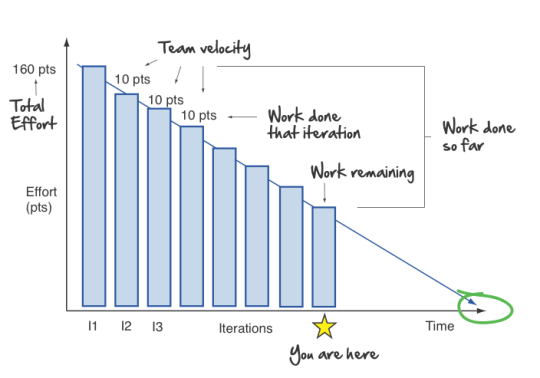
After a few sprints, data tells you how much work you’ve done. You want this value, known as the team’s velocity, to increase consistently, which is why you spend time on task estimation.
If your velocity starts to dip, it’s time to take a look at process and team performance to see what’s changed or needs to change. If your team experiences external interruptions that impact velocity, your objective data shows you the real-world consequence of outside forces on your sprint.
Finally, estimating your marketing work enables you to track the team’s ongoing output with a Burndown Chart – the number of points needed to complete the sprint vs. the number of days left in the sprint. Ideally, you plot a steep downward slope that simultaneously crosses zero on each axis.
Getting the Most Out of Standup Meetings
The second Scrum event, and one of the most powerful in the whole Scrum for marketing methodology, is known as the Daily Standup or Daily Scrum.
It takes place every day during a sprint; it is attended only by those who contribute directly to reaching the sprint goal; it features each team member discussing his or her progress and impediments.
It’s strictly timeboxed to 15 minutes, a limit to be enforced by the Scrum Master. During this Daily Scrum, each team member outlines:
- What they did yesterday to contribute to achieving the sprint goal
- What they plan to do today to contribute to achieving the Goal
- Barriers – the individual’s or the marketing team’s – that threaten achieving the Goal
Strictly speaking, no one who is not on the marketing team or directly contributing to the sprint goal(s) should attend the Daily Scrum.
Because team members rarely work on just one thing, it can be a challenge for each one to stay engaged while others share their updates. To counteract this common problem, follow Jeff Sutherland’s suggestion that the team adopt an approach to Daily Standup that’s closer to a football huddle than ticking boxes on a checklist:
"A wide receiver might say, “I’m having a problem with that defensive lineman,” to which an offensive blocker might respond, “I’ll take care of that. I’ll open that line.” Or the quarterback might say, “Our running game is hitting a wall; let’s surprise them with a pass to the left.” the idea is for the team to quickly confer on how to move toward victory -- i.e., complete the sprint. Passivity is not only lazy, it actively hurts the rest of the team’s performance. Once spotted, it needs to be eliminated immediately. I want aggressive teams -- ones that come out of the daily meeting knowing the most important thing they need to accomplish that day. One person will hear another say that a task will take a day, but another team member might know how to do it in an hour if they work together. I want teams emerging from that meeting saying things like, “Let’s nail this. Let’s do this.” The team needs to want to be great."
Sanctioned Showing Off in the Sprint Review
Sometimes called a sprint demo, this meeting happens at the end of a sprint once the work has been completed.
Unlike sprint planning and daily Scrum meetings, sprint reviews are open to anyone who wishes to attend.
The team shows off what they achieved during the sprint, including content, social media posts, email campaigns, new ads, etc. This is no time for quality assurance or edits; it’s a moment to review work that's completed and approved.
If you have work that was released earlier in the sprint, you can share any preliminary performance data that you’ve collected.
Sprint reviews often result in changes to the backlog, as stakeholders in attendance make adjustments based on what they see. They might want to adjust priorities to further iterate on an unexpected success, or they might choose to pull the plug on some dud in the backlog.
Finally, conduct your sprint review with an eye to your upcoming iteration.
Spend time considering the next steps for any projects to be included in future sprints. For example, if you create one branch of an email nurture campaign and plan to add another during an upcoming sprint, discuss and document any lessons from this iteration that might improve the execution of the next.
During the sprint review, look at changes in the marketplace, departmental priorities, budgets, or timelines so that they can be incorporated into future sprint planning.
Focus on the Team with the Sprint Retrospective
The final piece of Scrum is the sprint retrospective, a vital meeting in which the Scrum team inspects itself and its processes for opportunities to improve. Hold this meeting after the sprint review and before the next round of sprint planning, because outcomes from the Retrospective (sometimes abbreviated as Retro) almost certainly impact the next planning meeting.
Again, the retro isn’t just about preparing to plan; it’s about creating and using a safe environment in which the team does the work of identifying ways that they can improve and where they can grow as a unit. Post the retrospective prime directive somewhere in the retro meeting room:
"Regardless of what we discover, we understand and truly believe that everyone did the best job they could, given what they knew at the time, their skills and abilities, the resources available, and the situation at hand."
Traditionally, the sprint retrospective is structured around three questions: What should we stop doing next sprint? What should we start doing next sprint? What should we continue doing next sprint?
And, while these can certainly be helpful in launching a discussion about how the team can continuously improve its process, asking them over and over again during every single sprint retro can quickly lead to stagnation. Here are a few alternative ideas to help you mix things up. Even just shifting the questions around can generate new insights:
- Ask, “What went well? What went poorly? What should we change?”
- Have everyone describe the past sprint in one word by writing it on a sticky note. Then go around and ask each team member to explain why he or she chose that word.
- What’s something that caused problems last sprint? If you could change one thing about the last sprint, what would it be? What don’t we know yet?
- What did you Like, Lack, Learn, and Long For during the past iteration?
- Break down topics of discussion into what made the team Mad, Sad, and Glad.
Regardless of the structure you use, make sure that every member of the team has plenty of room to contribute.
Retros can also be a great time to discuss experiments you may have conducted during your sprint, reviewing the results and deciding whether to conduct a new test during your subsequent sprint or make a permanent change. This kind of regular experimentation is extremely valuable for things like implementing AI in marketing, so don’t neglect it!
Also, note that people who are uncomfortable speaking up may not work to make their voices heard, so the Scrum Master (or whoever is facilitating the meeting) needs to help them. Simply asking everyone to write their thoughts down on sticky notes first, and then having them share in turn, can prevent dominant personalities from taking over the meeting.
Make sure that your intense discussion culminates in some action that can be incorporated into your next sprint. To be effective, the concept of process improvement, also known as the kaizen, requires concrete, measurable changes. It frustrates a team to spend hours coming up with ways to function more effectively if, sprint after sprint, nothing changes.
Before you keep reading, The Ropes gives you 100+ hours of FREE Agile marketing courses, exclusive resources, and certification & coaching giveaways — completely free.


A Word About Sprints Themselves
They sound like something fancy, but for marketers, sprints are simply discrete periods of work done to achieve an objective. Some teams structure their sprints around completing a campaign or finishing a piece of a larger, ongoing project, but you need only ensure that the team is working on the most important set of tasks.
In the software world, each iteration exists to produce a potentially shippable piece of code – one that functions well enough to be released – but there’s no requirement to ship, or even release, at the end of each sprint.
For us, each sprint is an opportunity to rebalance priorities and adjust the plan based on new information. Since we work in a fast-paced digital world, systematizing this practice is enormously powerful, as Scott Brinker points out in Hacking Marketing:
"Overall, the management metabolism of short sprints isn’t about working harder or faster. It’s about dynamically reallocating our efforts more frequently, to take advantage of new information and innovations more quickly than quarterly or yearly plans permit. Yet it lets us do this in a considered and balanced manner, avoiding a chaotic, interrupt-driven frenzy. That’s agility."
Enjoying this article? The 9th Annual State of Agile Marketing Report goes even deeper. Grab your free copy below.
Scrum Artifacts for Marketing Teams
Sprints give Scrum its rhythm, but Scrum artifacts give the team visibility into what they’re working on, why it matters, and what “done” actually means.
In Scrum, the three core artifacts are the Product Backlog, the Sprint Backlog, and the Increment. For marketing teams, the names may need some translation, but the purpose behind each artifact still applies.
The Product Backlog is the prioritized list of work the team may take on in the future. In marketing, this might include campaign ideas, content updates, landing page tests, email sequences, creative requests, reporting improvements, events, or larger strategic initiatives. Whether you call it a Product Backlog, Marketing Backlog, or team backlog, the point is the same: give the team one visible, prioritized source of truth for upcoming work.
The Sprint Backlog is the work the team selects for the current sprint. It should include the specific tasks, projects, or experiments the team believes it can complete during the sprint, along with the sprint goal that explains why that work matters. For marketers, the sprint goal is especially important because it keeps the team focused on a shared outcome instead of a random collection of disconnected tasks.
The Increment is the completed work produced during the sprint. For software teams, that often means a usable piece of product functionality. For marketing teams, it could be a published landing page, a launched email campaign, a completed creative asset, an approved sales enablement piece, a finished report, or a tested experiment.
The final piece is the Definition of Done. This is the team’s shared agreement about what must be true before work can be considered complete. For example, a blog post may not be done when the first draft is written. It may only be done once it has been reviewed, optimized, approved, uploaded, published, and promoted.
These artifacts help Scrum teams avoid ambiguity. Everyone can see what work is coming next, what work is active now, what the team is trying to accomplish, and what counts as finished. For marketing teams dealing with shifting priorities and constant stakeholder requests, that visibility can make the difference between a sprint that stays focused and one that slowly turns into another messy to-do list.
Scrum Values for Marketing Teams
Scrum is not just a collection of meetings, roles, and artifacts. It also depends on a set of values that help the team use the framework effectively.
The five Scrum values are commitment, focus, openness, respect, and courage. For marketing teams, these values matter because Scrum often requires a real change in how work gets planned, protected, discussed, and improved.
Commitment means the team takes the sprint goal seriously and works together to deliver the most valuable work it can within the sprint. This does not mean blindly committing to unrealistic workloads. It means making thoughtful commitments and treating them as shared responsibilities.
Focus means protecting the team from constant priority changes and unnecessary distractions. In marketing, where urgent stakeholder requests can appear at any time, focus is one of the hardest Scrum values to maintain.
Openness means being honest about progress, blockers, risks, and what is or is not working. If a campaign is stuck in review, an experiment is not producing useful results, or the team is overcommitted, Scrum only helps if those realities are visible.
Respect means recognizing the expertise and constraints of everyone involved in the work. Content, design, demand generation, marketing operations, analytics, and leadership may all see the work differently, but Scrum depends on their ability to collaborate without turning every discussion into a handoff battle.
Courage means saying what needs to be said. That might mean pushing back on mid-sprint requests, admitting that the team took on too much, questioning a low-value initiative, or using a retrospective to address the process problems everyone has been quietly working around.
For marketing teams, these values are what keep Scrum from becoming a rigid meeting schedule. They create the conditions for transparency, inspection, and adaptation to actually happen.

Adapting Scrum Teams for Marketing
So far we’ve stayed pretty true to the Scrum practices that were created for software development teams. Sprint planning, Daily Standup, sprint reviews, and retros all work much the same for both. But when it comes to Scrum team members, we need to make more significant adjustments to make Scrum for marketing work.
Software Scrum teams consist of a Product Owner, the Development Team, and a Scrum Master. The Scrum Guide states how these teams function:
- Self-organizing teams choose how best to accomplish their work, rather than being directed by others outside the team.
- Cross-functional teams have all the competencies needed to accomplish the work without depending on others not part of the team.
- The team model in Scrum is designed to optimize flexibility, creativity, and productivity.
These functional ideals – self-organization and cross-functionality -- apply, and we optimize our Agile marketing teams for flexibility, creativity, and productivity; but our team structure often differs.
Agile teams work best without hierarchy among the team members.
But someone needs to manage the process of continuous improvement -- the traditional realm of the Scrum Master -- and we must have a liaison with stakeholders outside the team who manages the contents of the Backlog -- a function usually filled by the Product Owner.
Chiefmartec’s founder Scott Brinker suggests changing the Product Owner to a Marketing Owner, a title that makes more sense on marketing teams that aren’t actually producing a product.
In the case of the Scrum Master, most marketing organizations lack the resources (if not the will) to dedicate someone’s entire day to managing the Scrum process. The Marketing Owner may do double duty, serving as both the protector of the Backlog and the process facilitator (as illustrated above), or the responsibility may shift, monthly or quarterly, from one team member to another.
Moving Scrum Master responsibilities around like this can better help team members with little Agile experience see how the process works and why it runs as it does. It’s also an opportunity to regularly get a new perspective on the process and how it could work better for the team.
Don’t worry about getting each and every team certified as a Scrum Master if you plan to migrate the role, by the way; a basic understanding of Scrum principles is all you need to get started.
Choosing Your Scrum Team Size
The traditional formulation for Scrum team sizing is 7 plus or minus 2. Anything larger, and coordination becomes too difficult. The team – especially a distributed team – falls out of sync, and camaraderie and shared ownership fade.
Departments too big to fit into a single Scrum team can form multiple Scrum teams, based on project types (website, content, social media) audience segments, products, stages of the buyer’s journey, or whatever cross-functional groups help you achieve the greatest velocity.
Smaller teams can also work -- Jeff Sutherland says he’s seen Scrum work teams as small as three -- but lighter-weight methodologies, like Kanban, often work better for teams of that size.
How to Implement Scrum for Marketing
When you’re ready to take the plunge and actually start using Scrum, where should you start? Here’s a simple 5-step breakdown.
1. Get Buy-In from Teams and Leaders
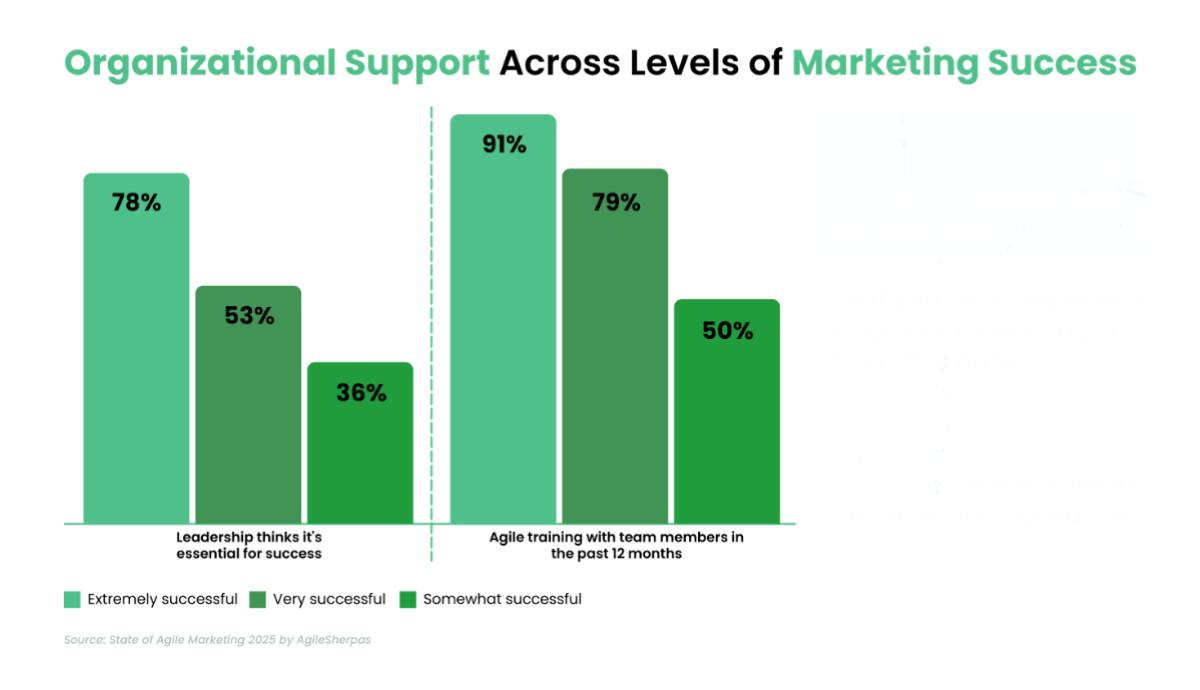
Getting Scrum to work well takes time and resources. One of the worst mistakes people make when implementing any Agile framework is doing so without leadership support. What happens is they fail to achieve the expected results within the first few weeks and the plug gets pulled. Everyone involved ends up worse off and the Agile well is poisoned for years to come.
It’s absolutely worth convincing leadership that Scrum for marketing is worth taking the time to do right. Our latest State of Agile Marketing Report found that marketers with leaders who felt Agile was essential for success were far more likely to be successful. Investments in training likewise contributed majorly to overall success, so you may want to consider that as a tool for building internal support and capabilities.
2. Plan How You Want to Adapt Scrum for Marketing
As we’ve discussed above, Scrum was not originally designed for marketing and needs some level of adaptation. Use the earlier sections in this article to think through what Scrum should look like for you. Here it may be helpful to employ an Agile coach with experience doing that.
It’s also important to remember that how you implement Scrum for marketing can (and likely will) change with time. For example, you might start with two-week sprints before deciding that three weeks makes more sense for you. So don’t feel like you have to get it perfect from the start.
3. Form Your Team(s)
Once you’ve got your plan ready it’s time to form your Scrum team! That means selecting who will be the product owner (that’s usually a given) and the Scrum Master. Bear in mind that being a Scrum Master will probably require some training or even a certification. Also don’t forget to make your teams cross-functional wherever possible.
4. Build Your First Backlog
Now you’re ready to kick off your first sprint. The first step is building a backlog of work you want to tackle during that sprint. Again, you’re probably not going to get this right at first. It’s normal to start off with too much or too little work. The point of Scrum for marketing isn’t perfection, it’s continuous improvement.
5. Test, Iterate, and Evolve
Speaking of continuous improvement, once your first sprint has commenced that is the name of the game. From this point on your goal is to use the events and structure of Scrum to conduct experiments, identify what can be improved, and generally hone your processes. Remember that this is never something you “complete” but a continuous process that’s at the core of Scrum.
Challenges of Implementing Scrum for Marketing
Playing Fast and Loose
We’ve mentioned here already but it’s worth saying again: Scrum relies heavily on structure for success. While some of its rules can be adjusted to meet the needs of Scrum for marketing, most really should not be tampered with. For example:
- Skipping events like standups or using them for unrelated discussions
- Filling your backlogs with vague requests that lack clear user stories and definitions of done
- Allowing stakeholders to make new work requests in the middle of sprints
- Allowing some team members to be part-time
- Taking on work that doesn’t fit into sprints
- Consistently over-committing to work in your sprints
- Having fluid or unclear roles for things like product owners or stakeholders
This is where working with coaches with extensive experience in adapting Scrum for marketing can help a lot. They can help you know the difference between changes that are fine to try and changes that might break the entire system.
Neglecting Retros
Retros are an essential driver of the continuous improvement that really makes Scrum work for marketing. It’s easy to get to the end of a sprint and say “well, I don’t know if we really did or learned enough to run a retro, so let’s skip it.” If you find yourself saying that, the issue is that you’re either not testing or experimenting enough or not giving team members enough opportunities to raise issues to discuss during the retro.
Scrum for Marketing FAQs
What is Scrum?
Scrum is an Agile framework that helps teams plan, prioritize, deliver, and improve their work in short, timeboxed cycles called sprints. It uses defined accountabilities, events, artifacts, and values to help teams work with more transparency, focus, and adaptability.
Is Scrum the same as Agile?
No. Agile is the broader mindset and set of principles behind flexible, iterative ways of working. Scrum is one specific framework teams can use to put Agile into practice. Marketing teams can be Agile without using Scrum, but Scrum can be useful when a team needs more structure, clearer priorities, and a predictable delivery cadence.
Does Scrum work for marketing?
Scrum can work very well for marketing teams when their work can be planned into short sprints, broken into manageable pieces, and protected from constant mid-sprint changes. It is especially useful for teams that need more structure, stronger prioritization, clearer collaboration, and regular opportunities to inspect and improve how work gets done.
When should marketing teams use Scrum?
Marketing teams should consider Scrum when they can organize their work into one- to four-week sprints, maintain a prioritized backlog, commit to a sprint goal, and limit ad hoc requests during the sprint. Scrum is often a good fit for campaign work, content initiatives, website improvements, email programs, experiments, and cross-functional marketing projects.
When should Scrum not be used?
Scrum may not be the best fit if your marketing team is constantly interrupted by urgent requests, cannot protect sprint commitments, struggles to define clear roles, or works mostly on tasks that do not fit into short delivery cycles. In those cases, Kanban or Scrumban may be a better starting point.
What are the main Scrum events?
The main Scrum events are the Sprint, Sprint Planning, Daily Scrum, Sprint Review, and Sprint Retrospective. In marketing, these events create a regular rhythm for deciding what matters most, coordinating daily work, reviewing completed work, gathering feedback, and improving the team’s process.
What are Scrum artifacts?
Scrum artifacts are the visible sources of information that help the team understand what work exists, what work is active, and what work has been completed. The three main Scrum artifacts are the Product Backlog, Sprint Backlog, and Increment. For marketing teams, these may translate into a marketing backlog, the work selected for the current sprint, and completed marketing work such as launched campaigns, published content, approved creative assets, or finished experiments.
What are the Scrum roles in marketing?
Traditional Scrum includes three accountabilities: Product Owner, Scrum Master, and Developers. In marketing, these may be adapted into roles such as Marketing Owner, Scrum Master or process facilitator, and the marketing team members who create and deliver the work. That group may include strategists, content marketers, designers, demand generation specialists, marketing operations professionals, analysts, and other contributors.
What is a Scrum Master in marketing?
A Scrum Master in marketing helps the team understand and use Scrum effectively. They facilitate the process, protect the team from unnecessary disruption, help remove blockers, encourage continuous improvement, and make sure Scrum events are useful rather than performative.
What is a sprint in marketing?
A sprint is a short, timeboxed period of work, usually lasting one to four weeks. During a marketing sprint, the team selects a set of prioritized work, commits to a sprint goal, coordinates progress through daily Scrums, reviews completed work, and uses the retrospective to improve before the next sprint begins.
What are the five Scrum values?
The five Scrum values are commitment, focus, openness, respect, and courage. For marketing teams, these values help protect sprint goals, make blockers visible, encourage honest feedback, support cross-functional collaboration, and give teams the courage to say no to low-value or disruptive work.
What is the difference between Scrum and Kanban for marketing?
Scrum organizes work into timeboxed sprints with defined events, accountabilities, artifacts, and sprint goals. Kanban focuses on visualizing work, limiting work in progress, and improving continuous flow. Scrum can work well for marketing teams that benefit from structured planning cycles, while Kanban may work better for teams with frequent unplanned work or a continuous stream of requests.
Will Scrum for Marketing Work For You?
Although Scrum is the most popular methodology, that doesn't mean it has to be your default choice.
For the right marketing team, Scrum can create the structure, focus, and delivery rhythm needed to manage complex work more effectively. It can help teams plan in shorter cycles, protect priorities, improve collaboration, and regularly inspect what is and is not working.
But Scrum works best when the team can commit to sprint-based work, limit mid-sprint interruptions, maintain a clear backlog, and use its events, artifacts, and values with discipline. If your team lives in a constant stream of urgent requests, a more flexible approach like Kanban or Scrumban may be a better place to start.
Think carefully about your team's needs, and be sure you're selecting a methodology that works in your unique context. The goal is not to “do Scrum” because it is familiar or popular. The goal is to choose the way of working that helps your marketing team deliver more valuable work with less chaos.
If you want to keep building that foundation, The Ropes Community can help. Inside The Ropes, marketers get free access to Agile marketing courses, practical resources, exclusive guides, and opportunities for coaching and certification giveaways.
Join The Ropes Community to strengthen your Agile marketing skills and find the approach that works best for your team.
If you read this far, you probably want to go deeper. The 9th Annual State of Agile Marketing Report has the full data — free to download below.
Topics discussed

Improve your Marketing Ops every week
Subscribe to our blog to get insights sent directly to your inbox.